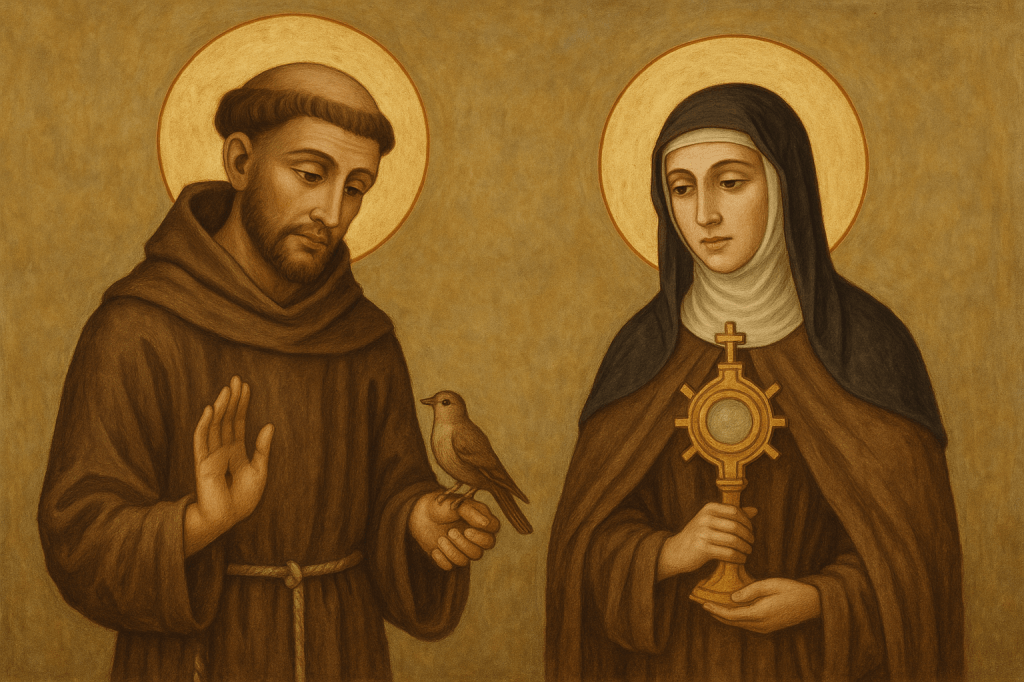
INITIAL FORMATION
Initial formation begins on the day the candidate is admitted to the Postulancy in our Order and lasts until the day of his definitive determination, sanctioned by solemn profession.
Initial formation in the FRANCISCAN ORDER OF DIVINE COMPASSION comprises three stages, namely: Postulancy, Novitiate, and the period of temporary profession.
The Postulancy is the time during which the candidate requests to embrace our life, with the intention of preparing himself suitably for the Novitiate, and the Fraternity, after appropriate and mutual acquaintance, matures its own response regarding his admission to the Novitiate.
In order to achieve the objectives of the Postulancy, the candidate receives from the brothers the necessary help to attain self-knowledge, to complete, if necessary, his initial Christian formation, to analyze the intimate motivations of his own vocation, and to acquire a gradual knowledge and experience of Franciscan life.
Candidates for the Postulancy must request it expressly and in writing from the Minister General. The minimum time for the postulancy is six months, except in particular cases examined by the Minister General and his Definitory.
The Novitiate, with which life in the FRANCISCAN ORDER OF DIVINE COMPASSION begins, is a period of more intense formation and has as its purpose that the novices come to know and experience the way of life of Saint Francis of Assisi, that they conform their minds and hearts to his spirit, and that, with greater certainty regarding the call of the Lord, their purpose and suitability may be tested. The canonical time for the novitiate is twelve months.
Once the time of the Novitiate has been completed, the novice, if judged suitable, is to be admitted to temporary profession, by virtue of which he is incorporated into the FRANCISCAN ORDER OF DIVINE COMPASSION.
Temporary profession is the period during which formation is completed so as to live more fully the life proper to the Order and to fulfill its mission more effectively; moreover, the brothers prepare to make solemn profession. Canonically, this period is three years, extendable up to six years, according to the judgment of the Minister General and his Definitory, having considered the formative report of the brothers.
Brothers in temporary profession must continue formation specifically Franciscan in its various aspects, both theoretical and practical, and, if it is judged opportune, in union with other members of the Franciscan Family. This formation is to be given to all the brothers according to the Constitutions, in which the conditions, duration, and program are specified.
Once the period of temporary profession has been duly completed, which in the Order is three years, the brothers who freely request it and are found suitable are to be admitted to solemn profession, by which they are definitively incorporated into the FRANCISCAN ORDER OF DIVINE COMPASSION.

What is Religious Life?
Religious men and women are those persons who consecrate themselves to God and who are part of a religious congregation. Many times people call them “nuns” or “friars”…
1.- What does “religious” mean?
Religious men and women all share three characteristics in common:
They have consecrated their lives to God through the public vows of poverty, chastity, and obedience in a religious institute. They live in communities where they share their experience of faith. They renounce the world. This does not mean that they ignore the world, but rather that they renounce the material concerns to which the world invites them.
2.- Are all religious priests?
No. There are religious institutes in which there are priests and brothers who are not priests. There are even congregations composed exclusively of Brothers who are not ordained priests. Nor are women’s congregations priestesses.
3.- Then, are there “religious” priests and other priests who are not?
Indeed. There are priests who belong to a religious institute and others who do not.
“Diocesan” priests do not belong to any particular religious institute but to a diocese. The superior of a diocesan priest is the Bishop of the diocese in which he was ordained a priest.
4.- Which of the two options is better?
Human beings are always comparing… In this matter there are no options that are better than others. Each person individually must ask where God wants them and act accordingly.
In the life of faith, the best place is to be where God wants us. Whoever is called to religious life, as a religious, and whoever is called to diocesan life, as a diocesan priest. Each one must discover the place from which to serve the Lord and others.
5.- What is religious life?
Religious Life is a way of life that helps its members to grow, humanly and spiritually, through the specific following of Jesus Christ, by means of service and presence in the world and in the Church.
6.- What is an institute of consecrated life?
They are communities of persons consecrated to God with the sole purpose of following and imitating what Christ lived and preached. To achieve this, they come together to live in common what Jesus entrusted to them individually through their personal vocation.
7.- What is done in orders, congregations, or religious institutes?
In summary, it can be stated that the mission of religious institutes is to carry out in today’s world the program of life brought by Jesus: his self-giving, his sacrifice, his proclamation of the Kingdom of God, his love…
In religious congregations, the foundations are laid so that their members may carry out an effective service of love, through a particular form of spiritual life and self-giving to others.
There are congregations that carry out a wide variety of activities. Each religious institute performs its own specific ones. All the fields of work of institutes of consecrated life fall within these four broad categories:
1.- Contemplative:
They devote themselves to prayer, study, and work within their communities (monasteries). Their way of life is one of enclosure, that is, they do not leave their communities without a truly serious reason.
2.- Apostolic institutes:
They devote themselves primarily to preaching, evangelization, missions, teaching, catechesis, study, and, in general, to everything that contributes to communicating and proclaiming the message of Jesus.
3.- Institutes dedicated to works of charity:
Their task is the care of the poor, the sick, the abandoned, children, etc.
4.- Secular institutes:
Their members do not withdraw from their normal activities, such as work, study, family life, etc., but continue living these same everyday realities. They remain in the world with the mission of sanctifying it from within its own structures.
8.- What will you find in religious life?
The first thing that happens to a person when entering religious life is encountering many traditions, works, different houses, new people in their life, proper customs and practices… At first all this can seem somewhat disconcerting.
The newcomer may feel a bit like a “fish out of water.” He or she does not know for certain whether adaptation will be possible… In most cases, all of this is resolved over time and through the gradual assimilation of the new way of life. One must know how to accept what cannot be changed, but also be radical in the love that comes to us from God.
Each founder had a very particular vision when creating a new congregation. Those who choose one or another religious congregation must know how to identify with the founder’s charism as transmitted by that congregation.
9.- What is the “charism” of a congregation?
The word “charism” comes from the Greek language and means something like a “gift of grace.” In other words, it is the gift, the grace that God grants to a person for the benefit of the community. Each one, according to the gift God has given, serves the brothers and sisters in community.
Charisms are given to all believers in the Church.
When one speaks of the “charism of a congregation,” one means the purpose, the mission, or the identity of a particular institute—its objective in the Church and in the world.
When the question is asked, “What is the charism of the congregation?” one is asking about the work and spiritual life that a congregation carries out in the Church, about its style of life, and about the deep motivations that inspire it.
To dedicate oneself to teaching, to the sick, to missions, etc., with specific “charisms.”
10.- How is a religious congregation “governed”?
Like any human group, religious also have rules that regulate their community life; however, there is certainly a clear difference between the regulations of religious life and those of any other group.
Sometimes these rules have been understood as restricting the freedom of those who choose this way of life. Nothing could be further from the truth. Whoever truly chooses Jesus sees the authentic meaning of having concrete norms that help make one freer and closer to the realities of God and of people in general.
The principal rule or norm of life for religious is the Gospel. In it is found the light of the Word of God that encourages their journey.
The principal “Superior” is Jesus. Through his presence in the community, he seeks to serve better, through their lives, the cause of the Kingdom of God in today’s world.
There are, nevertheless, a series of concrete norms that guide this community and fraternal life:
1.- Code of Canon Law:
It contains the general norms for all institutes of consecrated life. These are norms of universal law and are valid for the entire Catholic Church of the Latin Rite.
2.- Local norms:
These are promulgated by each bishop of the place where a religious house is located.
3.- The Constitutions:
These are the proper norms by which a religious institute is governed. Each congregation has its constitutions:
If these constitutions are approved by the diocesan bishop, the congregation is called of “diocesan right.” If, on the other hand, the constitutions are approved by the Metropolitan See, it is called a congregation of “Metropolitan right.”
11.- Who “rules” in religious congregations?
In each congregation there are a series of missions or offices that have been conceived, from the beginning of the Church, as realities at the service of the brothers and sisters. Superiors encourage, from their position, with the strength of the Spirit who acts among all religious, and they animate the communities, guide and stimulate them through service to their brothers and sisters…
These services are:
The Superior General of a religious congregation: He is, after the Pope, responsible for the entire congregation throughout the world. The Superior General is assisted by general councillors. The Provincial Superior: Each religious congregation is divided into religious Provinces. The boundaries of each province do not have to coincide with social or political boundaries. Each congregation establishes its own religious Provinces. The Provincial Superior has direct responsibility for the activity of a congregation in a particular country or region. The Provincial Superior is also assisted by provincial councillors. The Local Superior: He has direct responsibility for serving the brothers of a particular house. Likewise, the Local Superior is assisted by local councillors elected by the community.
12.- Who can be a religious?
First of all, it should be understood that there is a universal call to Christian perfection. Every Christian is called to follow the example of Jesus. Within this universal call to perfection, there are some members of the Church community who, through vocation, choose a following of Christ in religious life.
To be a religious man or woman, therefore, it is necessary to have a vocation to this way of life: to be willing to share one’s existence with others, to find meaning in community life for the following of Jesus, to be capable of assuming concrete commitments of spiritual and material life…
The requirements demanded to be a religious man or woman in the Franciscan Order of Divine Compassion are:
~ To be Catholic (of any tradition: Orthodox, Roman, Anglican).
~ To be baptized and confirmed.
~ To have a vocation and right intention.
~ To have good psychological and physical health.
~ To possess an appropriate character and sufficient maturity proportionate to age.
~ To be over 20 years of age and under 36 years of age.
~ To have sufficient qualities to follow the chosen path.
~ To be single, widowed, or lawfully married. Single or widowed persons must have availability to be transferred to any place and office. Married persons may remain in their homes, but always bound by obedience to a pastoral office.
~ To have completed secondary studies (for those who will be lay brothers) and/or university studies (for those who will be clerical brothers).
~ To possess sufficient capacity for work for self-support.
~ To have the ability and charity to attend to the poor in any condition, age, and place (those lacking hygiene, addicts, the elderly, juvenile offenders, sex workers and transgender persons, the terminally ill or those with infectious diseases, etc.).
~ To be willing to serve the poorest among the poor, always and in any circumstance or schedule.
~ Not to seek economic dependence, comforts, or any other security in religious life apart from God.
~ Not to seek the community as a time of EXPERIENCE, rest, refuge, or as a way to overcome frustrations.
The choice for religious life must be completely free. The person must be capable of adjusting to the norms of the chosen congregation.
13.- What do I have to do to become a religious?
First of all, you must discover within yourself the call of the Lord: your vocation. Through it you will understand your mission of service to the community and what God’s will is for your life.
To help you discover your vocation, a priest, religious man or woman, or a suitably formed Christian may guide you.
Once you have carried out the appropriate vocational discernment and discovered God’s will in your life, you must take a second step: to find an institute of consecrated life in which you believe you will be able to carry out the mission of service that Jesus Christ has entrusted to you in a particular way.
Generally, you will have to initiate contact with the congregation you have chosen. This contact may be personal or by letter or email.
After maintaining contact for a more or less extended period, you will enter the postulancy, which lasts about six months, although this depends on the Superior who has admitted you.
Once the period of postulancy is completed, you will enter the Novitiate.
14.- What is the Novitiate?
It is a period of trial. It is equivalent to courtship in a couple’s relationship.
During this novitiate you will come to know what the religious institute you intend to enter is like: its style of life, its forms of apostolate, its history, its spirituality, etc.
The novitiate has a minimum duration of one year and a maximum of two years. During this time you will reflect, assess your strength, pray, learn the advantages of such a form of religious life and also its inconveniences…
Everything you learn in the novitiate will be taught to you by a religious who will accompany you in a special way during your time as a novice. This religious man or woman is the master/mistress of novices. He or she will be at your side during this year or two years (depending on the congregation), and will help you come to know yourself better and the congregation you intend to enter after the novitiate.
To enter the novitiate you will need to present:
Certificate of Baptism. Certificate of Confirmation.
Likewise, the superiors may require any other data, document, or information they consider appropriate.
The novitiate is also a time of formation. During this formative time you will live in community with other companions who share your same desire to serve the Church and the world. God’s grace has led them to understand that service to one’s brothers and sisters is the best of paths…
You will go deeper into your vocation. You will clarify your path more clearly. Little by little your doubts will find answers. In short, you will be formed to know yourself better in your relationship with God and with others.
This period, so important in the life of an aspirant, requires all your attention and all your effort. For this reason, during the novitiate no studies with academic validity may be undertaken.
During the time of the novitiate you do not acquire any strict obligation with the congregation and therefore, at any moment, you may leave the novitiate; or the congregation may dismiss you.
15.- What is “religious profession”?
You have spent one or two years in the novitiate. You already know the history, spirituality, and lifestyle of the congregation you wish to join. You have come to know the positive aspects as well as the human shortcomings of the members of the congregation you have chosen. Likewise, you have come to know your own defects and your good qualities. But God has prevailed. You have decided to take a very important step in your life: you want to be a servant of your brothers and sisters and of the men and women of this time. God and you have made a singular covenant of love: God will give you the strength of faith. You will place your freedom at his service, because you know that where there is love there is always more freedom…
The time has come to make a rather serious decision: to consciously choose to be a religious man or woman; this is “religious profession.”
The time has come to make the First Profession.
16.- What is the First Profession?
Once the period of novitiate has been satisfactorily completed, you may make the first profession. To do so, you must meet the following requirements:
To be at least eighteen years of age. To have validly completed the novitiate. To be freely admitted to first profession by the superior. That the first profession be made freely and voluntarily on your part.
With first profession you are incorporated into a religious congregation as an active member and assume all its duties and rights. Once you have made first profession, you are already a religious.
17.- What is a “temporary” profession and what are “the vows”?
The first profession is a “temporary” profession; that is, each year, on the same day you made first profession, you must renew it. You may renew the profession (your will to remain in the congregation) for a period of up to nine years. Once the maximum of nine years of temporary renewals has been reached, you must make perpetual profession or leave the congregation.
In the first profession you assume for the first time and publicly your three vows of:
poverty chastity obedience
You commit yourself to observe these three vows for one year if they are temporary vows, and forever if they are perpetual vows, which are made in perpetual profession.
18.- What is “perpetual” profession?
From the time of first profession, you are already a religious.
Some time has now passed since that exciting day of first profession. Now you are studying and being formed for the priesthood or another technical specialty. You may already be inserted into a community of life, work, and prayer. Each year you renew your three vows, which you live in community…
With “perpetual” profession you commit yourself definitively, for life, to God and to your religious institute. After making perpetual profession, you will no longer have to make temporary renewals, but you have chosen for life the ideal and following of Jesus Christ within religious life, to love and serve the men and women of our time.
To make perpetual profession, the following are required:
To have made temporary profession for at least three years. To be admitted by the Major Superior. To be free in making it. To be at least twenty-one years of age. That perpetual profession be received by the legitimate superior.
With your perpetual profession you have definitively chosen to continue affirming that God remains present in the realities of our world. That others are not hell, as some contemporary philosophy has claimed. Others are your brothers and sisters, because you have discovered that Jesus truly makes us brothers and sisters and that God is indeed our Father.

 SS. Francis & Clare of Assisi Anglican Church